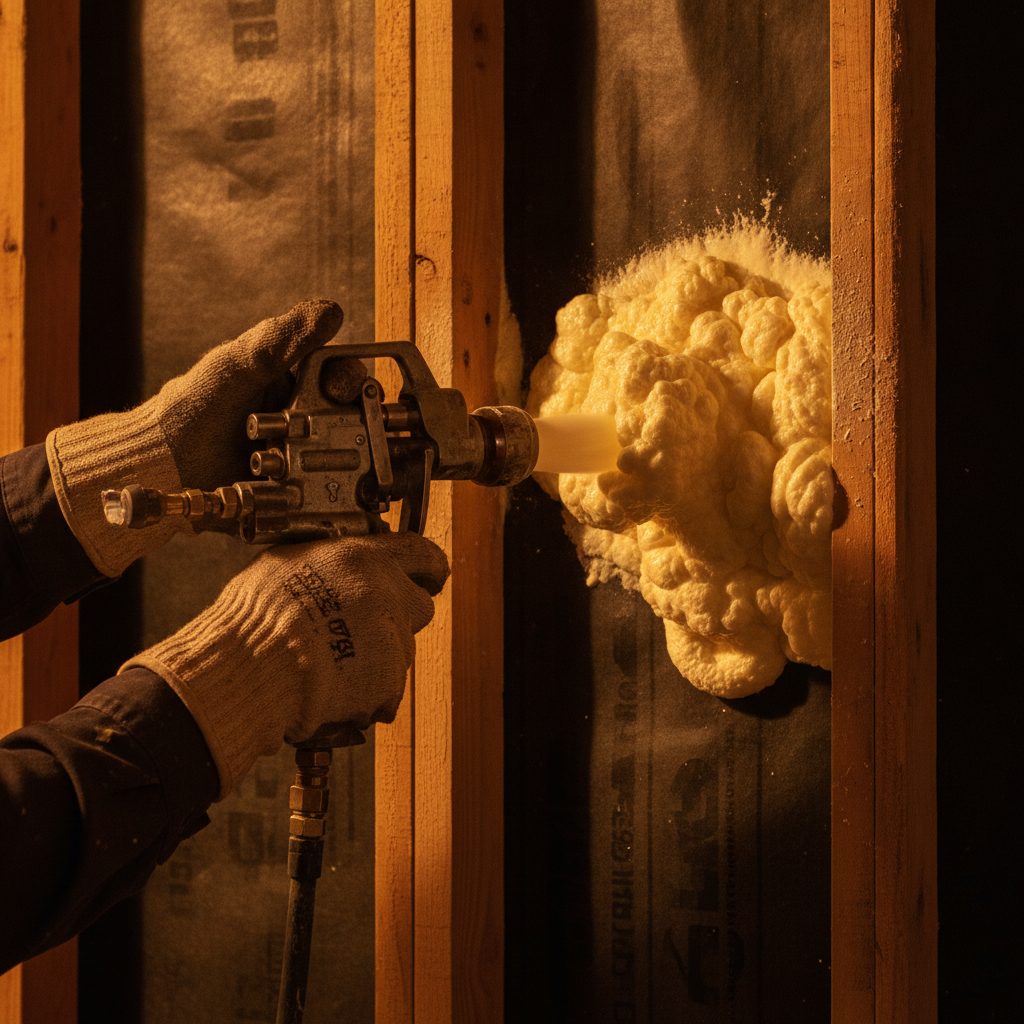
VR in Spray Foam
Why Spray Foam Application Is a Natural Fit for VR Training
The specific mechanics of SPF application — spray-gun distance, pass speed, overlap, ratio awareness — are motor-skill and judgment tasks VR simulation is built to drill without wasting material.
VR training works best on tasks that are motor-skill-and-judgment-heavy, expensive to practice with real materials, and have a clear right-or-wrong outcome a simulation can score. Spray foam application matches that profile unusually well — arguably better than many trades currently getting VR training investment.
Spray-Gun Distance, Angle, and Pass Speed Are Learnable Motor Skills
Correct SPF application technique depends on holding the spray gun at a consistent distance and angle from the substrate, moving at a controlled pass speed, and maintaining even overlap between passes to avoid gaps or excessive buildup. These are genuinely learnable, correctable motor skills — not tacit knowledge that resists simulation. A trainee spraying too fast, too far away, or with inconsistent overlap produces a visibly identifiable pattern that a VR system could score and give immediate corrective feedback on, the same way a golf or archery VR trainer scores form.
Every Practice Pass in Real Life Costs Real Material
Unlike a skill you can practice with cheap or reusable materials, every square foot a trainee sprays with real chemistry consumes actual A-side and B-side material at real cost, whether the technique was correct or not. A new hire's early, mistake-heavy passes are a genuine expense to a contractor's business — which creates a real incentive to minimize how many real-material reps a trainee needs before they're producing acceptable work. VR removes that cost entirely from the early-rep phase of learning.
Ratio Awareness Is a Judgment Skill, Not Just Equipment Operation
Beyond the physical spray technique, a competent installer needs to recognize the visual and tactile signs of an off-ratio mix in real time — excessive shrinkage, unusual tackiness, or an odor that doesn't match a correctly curing job — and know to stop and check the proportioner rather than keep spraying. That's a pattern-recognition and judgment skill that's genuinely hard to teach in the abstract and dangerous to teach by letting a trainee spray an entire off-ratio wall before catching the problem. A simulation that can present a trainee with a deliberately off-ratio scenario and test whether they catch it is teaching something a live job usually can't safely teach on purpose.
Where the Fit Isn't Perfect
The honest limitation: VR can't currently replicate the actual physical resistance and weight of a loaded spray gun and hose, the real thermal sensation of a heated hose and proportioner setup, or the tactile feedback of foam expanding against a real substrate. Haptic controllers are improving but don't fully reproduce those sensations yet. VR is a strong fit for the judgment and procedural side of SPF application — it isn't a complete substitute for eventually spraying real material under real supervision, a distinction covered in more depth on the VR vs. Traditional Hands-On Training page.
Key Takeaways
- Spray gun distance, angle, pass speed, and overlap are scoreable motor skills — a strong technical match for VR training's proven strengths.
- Every real-material practice pass costs a contractor real money regardless of whether the trainee's technique was correct, which is a direct financial incentive for simulation-based early reps.
- Recognizing off-ratio mix symptoms in real time is a judgment skill VR could safely simulate by deliberately presenting a bad scenario — something a live job can't safely teach on purpose.
- VR can't yet replicate the physical weight, heat, and tactile feedback of real spray equipment — it complements, not replaces, eventual hands-on training.
Common Questions
Why SPF Fits VR FAQs
Real questions people ask about VR's role in this trade.
Related Topics
VR Safety Training for Spray Foam Installers
Why isocyanate exposure risk and respirator/PPE drilling make spray foam application a strong candidate for VR-based safety training — drawing on real precedent from adjacent trades.
Read moreVR Sales Visualization: 3D Cutaway Walls for Homeowners
How a 3D cutaway VR walkthrough of insulated vs. uninsulated walls could help homeowners understand what they're actually buying — before a single can of foam is sprayed.
Read moreThe Technology Behind VR Jobsite Training
Headsets, haptic controllers, and photogrammetry-captured job sites — the actual hardware and software stack real VR trade-training programs are built on today.
Read more
Curious Where This Goes Next?
Get on CCA's list for updates as VR training and sales-visualization tools develop for the spray foam industry — free, no obligation, no product to buy today.