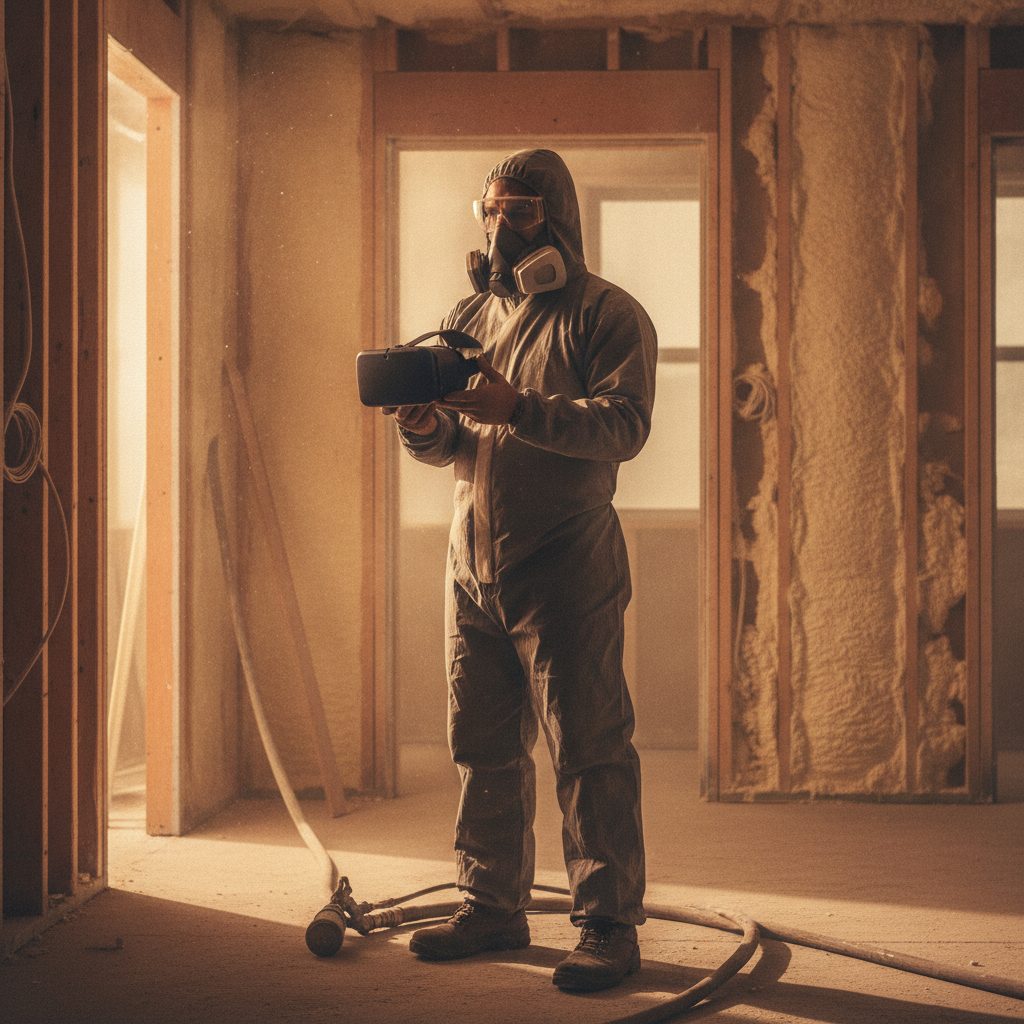
VR in Spray Foam
The Future of VR in the Spray Foam Industry
A realistic adoption timeline for VR in spray foam — why it hasn't happened yet, what would need to be true for it to happen, and who's likely to build it first.
A realistic adoption timeline requires being honest about where this industry actually is today: near-zero real search demand for "spray foam VR," zero dedicated products, and one relevant but adjacent-trade precedent. That's not a reason to dismiss the idea — it's the accurate starting point for a real forecast instead of a hype cycle.
Why It Hasn't Happened Yet
Three factors explain the current gap better than "the technology isn't ready": market size (SPF's installer base is smaller and more fragmented than roofing's national-brand-dominated market), lack of a first-mover with both the safety-training motivation and the marketing budget PIXO VR's roofing partners had, and the fact that SPF's chemical-exposure hazard profile is harder to build accurate training content for than roofing's fall-hazard profile, requiring closer collaboration with industry safety bodies like SPFA.
What Would Need to Be True for Adoption to Start
A realistic trigger would be one of: a large SPF manufacturer (BASF, Huntsman/Icynene-Lapolla, Carlisle, or similar scale) deciding VR safety training is worth the R&D investment the way Owens Corning did in roofing; an existing enterprise VR training vendor like PIXO VR proactively building a spray-foam module to expand their trade-training catalog beyond roofing; or a major insurance/liability driver making VR-verified safety training documentation valuable enough for underwriters or code officials to effectively require it — a pattern seen in other high-hazard trades' safety-training evolution.
Sales Visualization Likely Moves Faster Than Safety Training
Of the two use cases covered on this site, VR sales visualization has a shorter realistic path to market because it builds on already-mature real estate and architectural VR walkthrough technology rather than needing bespoke haptic/procedural training tools. A manufacturer or large regional contractor group adapting an existing home-visualization VR platform with an insulation-comparison module is a smaller lift than building a full OSHA-aligned safety-training product from scratch.
What We'll Do If Something Real Launches
This site exists specifically so that when something real does launch — a genuine spray-foam-specific VR safety-training module, or a genuine sales-visualization tool grounded in real thermal physics — we cover it accurately, sourced, and without the hype that a vendor's own marketing would naturally carry. Until then, the honest position is that this is a plausible, well-precedented-in-adjacent-trades emerging technology, not a product anyone can currently buy.
Key Takeaways
- The current gap is best explained by market size, lack of a funded first-mover, and SPF's harder-to-simulate chemical hazard profile — not by VR technology being unready.
- A large manufacturer, an existing enterprise VR training vendor, or an insurance/liability driver are the three most realistic triggers for adoption to begin.
- Sales visualization likely arrives before safety training, since it builds on already-mature real estate/architectural VR technology rather than bespoke haptic training tools.
- This site's role is to cover real developments accurately and sourced if and when they happen — not to claim they've already happened.
Common Questions
What Comes Next FAQs
Real questions people ask about VR's role in this trade.
Related Topics
VR Safety Training for Spray Foam Installers
Why isocyanate exposure risk and respirator/PPE drilling make spray foam application a strong candidate for VR-based safety training — drawing on real precedent from adjacent trades.
Read moreVR Sales Visualization: 3D Cutaway Walls for Homeowners
How a 3D cutaway VR walkthrough of insulated vs. uninsulated walls could help homeowners understand what they're actually buying — before a single can of foam is sprayed.
Read moreWhy Spray Foam Application Is a Natural Fit for VR Training
The specific mechanics of SPF application — spray-gun distance, pass speed, overlap, ratio awareness — are motor-skill and judgment tasks VR simulation is built to drill without wasting material.
Read more
Curious Where This Goes Next?
Get on CCA's list for updates as VR training and sales-visualization tools develop for the spray foam industry — free, no obligation, no product to buy today.