VR in Spray Foam
VR Training vs. Traditional Hands-On Training
What VR simulation can and can't replace in spray foam training — an honest look at the tradeoffs, not a pitch that VR replaces the spray gun.
None of this page's argument is that VR should or could replace hands-on spray foam training entirely. The honest, useful framing is which parts of training VR is well-suited to take over, and which parts still need a real spray gun, real material, and real supervision — a distinction worth being precise about instead of overselling.
What VR Training Is Genuinely Good At Replacing
Early-stage procedural learning — safety protocol, equipment familiarization, recognizing hazard and off-ratio warning signs, and repeated low-stakes practice of spray-gun distance/angle/pass-speed judgment — is exactly the category of training VR has already proven effective for in adjacent trades. These are reps a trainee can safely fail repeatedly, with immediate feedback, at zero material cost and zero chemical exposure risk. There's a strong, evidence-backed case that this portion of training should move to VR wherever a real program exists.
What VR Training Cannot Currently Replace
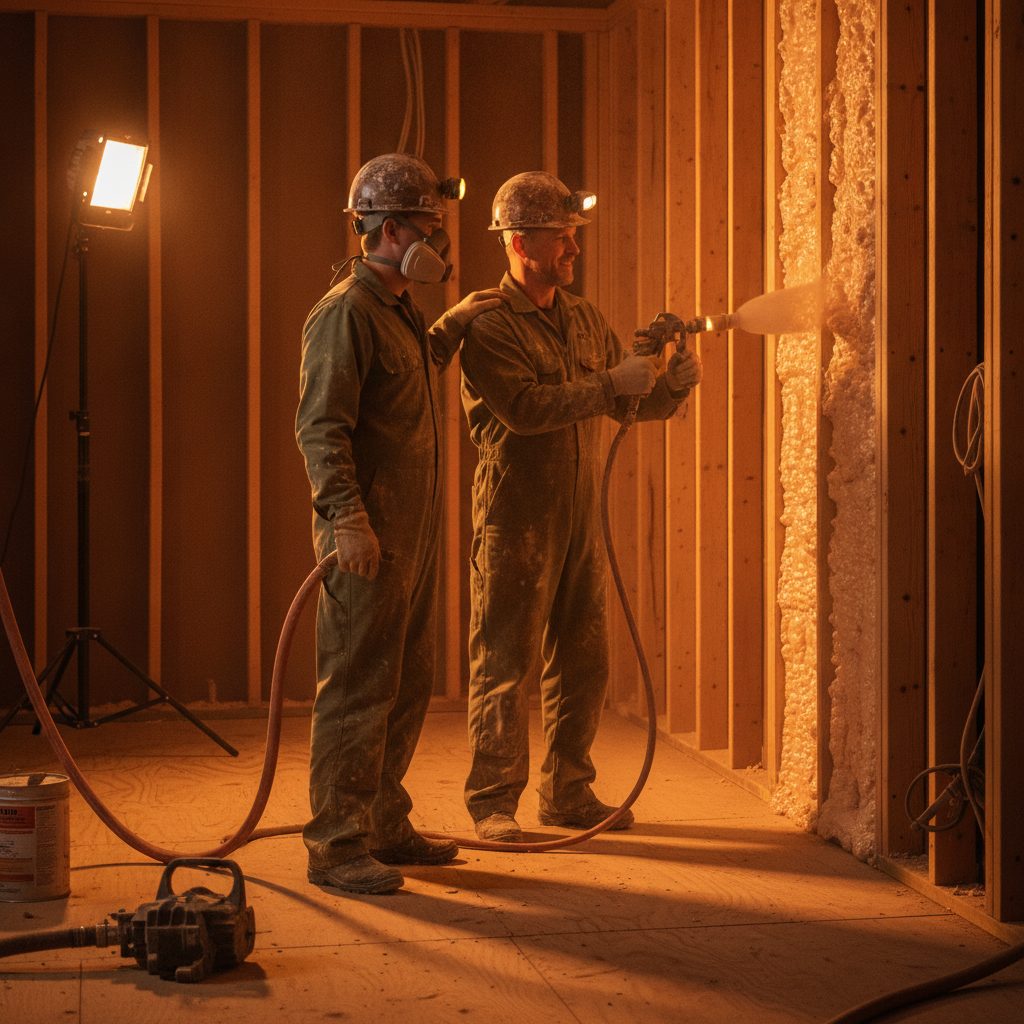
The physical sensation of a loaded spray gun's weight and recoil, the real thermal feel of a heated hose system, and how real foam actually expands and cures against a real substrate under real ambient conditions (temperature, humidity, substrate moisture) are not things current VR and haptic technology reproduce with enough fidelity to certify someone as job-ready. A trainee who has only ever sprayed in VR has not yet developed the tactile calibration that comes from feeling how the gun and material actually behave — that has to happen with real equipment and real material, under real supervision, before someone sprays unsupervised.
The Realistic Model: VR First, Then Supervised Real Application
The programs that exist in adjacent trades (again, Owens Corning/PIXO VR in roofing is the clearest sourced example) use VR as a first stage — building procedural competence and hazard awareness before a trainee touches real material — rather than a total replacement for hands-on apprenticeship. If a spray foam program followed that same model, the honest pitch would be: VR training reduces the number of costly, risky early real-material reps a trainee needs, and produces a trainee who arrives at their first real supervised spray session already knowing the safety protocol and having already practiced the motor pattern — not a trainee who's ready to work completely unsupervised.
Why This Distinction Matters for Anyone Evaluating a Future VR Product
If a spray foam VR training product does eventually launch, the honest way to evaluate it is exactly this way: what specific pre-application skills does it claim to build, and does it make any claim about replacing real hands-on supervised practice? A product that positions itself as complementary to hands-on training, reducing risk and cost in the early learning phase, is making a credible claim. A product that positions itself as a full replacement for supervised real-material training is overselling what current VR and haptic technology can actually do.
Key Takeaways
- VR training is well-suited to replace early procedural learning: safety protocol, hazard recognition, and low-stakes practice of spray-gun judgment skills.
- VR cannot currently replicate the physical weight, heat, and tactile feedback of real spray equipment or real material behavior under real conditions.
- The credible model, based on real adjacent-trade programs, is VR-first-then-supervised-real-application — not VR as a total replacement for hands-on apprenticeship.
- Any future spray foam VR product should be evaluated on whether it claims to complement or replace hands-on training — the honest claim is complement.
Common Questions
VR vs. Hands-On FAQs
Real questions people ask about VR's role in this trade.
Related Topics
VR Safety Training for Spray Foam Installers
Why isocyanate exposure risk and respirator/PPE drilling make spray foam application a strong candidate for VR-based safety training — drawing on real precedent from adjacent trades.
Read moreVR Sales Visualization: 3D Cutaway Walls for Homeowners
How a 3D cutaway VR walkthrough of insulated vs. uninsulated walls could help homeowners understand what they're actually buying — before a single can of foam is sprayed.
Read moreWhy Spray Foam Application Is a Natural Fit for VR Training
The specific mechanics of SPF application — spray-gun distance, pass speed, overlap, ratio awareness — are motor-skill and judgment tasks VR simulation is built to drill without wasting material.
Read more
Curious Where This Goes Next?
Get on CCA's list for updates as VR training and sales-visualization tools develop for the spray foam industry — free, no obligation, no product to buy today.